

Workers on the move: How labor mobility is quietly buffering China's economy against heat-driven losses
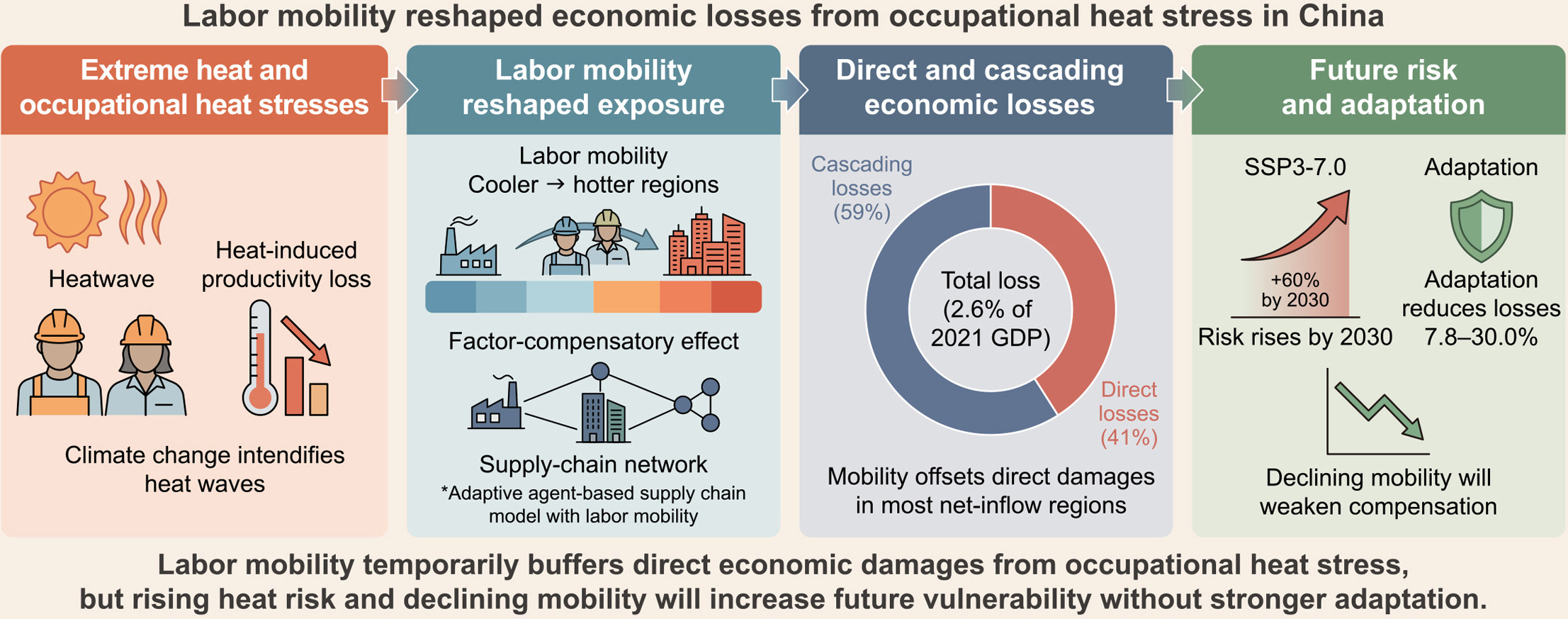
Labor mobility buffers heat-induced supply-chain losses.
GA, UNITED STATES, July 10, 2026 /EINPresswire.com/ -- As global temperatures rise, occupational heat stress is emerging as a major threat to economic stability, yet current risk assessments often miss the bigger picture. A new study reveals that the movement of workers between cities—a factor previously overlooked in climate economics—reshapes where heat-related productivity losses land as they ripple through supply chains. By tracking daily migration data across 313 Chinese cities, researchers found that labor mobility acts as a modest but systematic buffer—offsetting billions of CNY nationwide while redistributing risk between regions.. The findings challenge conventional risk models and highlight the need for coordinated, network-level climate adaptation strategies.
Climate change is escalating the frequency and intensity of extreme heat, pushing outdoor and indoor workers to precarious productivity thresholds. While the direct impact on individual laborers is well-documented, conventional economic models often operate at coarse annual and national scales, masking highly unequal sub-national vulnerabilities. Moreover, these models have historically ignored a crucial dynamic of modern economies: the daily movement of people. As transportation makes mobility faster and cheaper, workers are relocating in search of better opportunities, a trend that simultaneously redistributes risks and alters a region's capacity to withstand heat shocks. Based on these challenges, there is a need for a more granular, dynamic approach to investigate how this demographic flux influences the cascading economic consequences of occupational heat stress.
A research team from the School of Management at Beijing Institute of Technology, publishing their findings in Environmental Science and Ecotechnology, has developed a high-resolution agent-based model to simulate the economic impacts of heat exposure. By integrating empirical daily mobility data from the Baidu Migration Platform with climate and economic datasets, the team created a dynamic supply chain network to quantify both direct labor losses and indirect "cascading" effects across 313 Chinese cities.
The study's simulation reveals a complex interplay of risk redistribution. Over the 2021–2022 period, occupational heat stress cost China approximately 2,933.5 billion Chinese Yuan (CNY), equivalent to 2.6% of its gross domestic product (GDP). Strikingly, 59% of these losses were not direct productivity hits but were indirect losses propagated through upstream and downstream supply chain connections. When the researchers accounted for labor mobility, they discovered a "factor-compensation effect": net labor inflows into hotter, industrialized southeastern regions provided enough extra workforce capacity to offset local productivity declines. This movement saved a net 7.2 billion CNY in direct losses and an additional 24.6 billion CNY in indirect losses nationwide. The analysis further showed that under a 2030 warming scenario based on the Shared Socioeconomic Pathway 3-7.0 (SSP3-7.0), total losses could expand 1.6-fold. However, the study also demonstrated that integrated multi-level adaptations—combining industrial restructuring with work-hour shifts—could mitigate these future losses by up to 30%.
"The conventional wisdom has been to treat heat stress as a local productivity problem, but our findings show that demographic mobility changes the economic geometry of climate vulnerability," the authors said. "We found that labor moving to a hotter region doesn't necessarily exacerbate the economic crisis; in fact, it can build economic resilience by compensating for lost production capacity—though this concentrates heat exposure among the workers who move.. While this movement helps buffer national losses, it also redistributes risks, making less-developed regions with outbound migration more vulnerable. This tells us that isolated local policies are insufficient—we need synchronized, network-level interventions to build true resilience."
The study provides a robust analytical framework for policymakers to design targeted, high-resolution early warning systems and intervention strategies. For businesses, the data highlights the importance of flexible work-hour policies and workforce planning in high-risk industrial sectors like agriculture and construction. The results also underscore a potential long-term vulnerability: as China's urbanization slows and balanced development policies take hold, this compensatory labor flow may decrease. If mobility declines while climate change intensifies, the buffering effect could weaken, exposing deeper economic inequalities. This necessitates proactive planning to ensure that adaptation measures specifically address the needs of net labor-outflow regions, thereby decoupling economic resilience from demographic influx.
References
DOI
10.1016/j.ese.2026.100727
Original Source URL
https://doi.org/10.1016/j.ese.2026.100727
Funding information
This work was supported by the National Natural Science Foundation of China [grant numbers 52425005, 52370189, 52200228], the Jing-Jin-Ji Regional Integrated Environmental Improvement National Science and Technology Major Project [grant number 2025ZD1202203], and the Beijing Laboratory for System Engineering of Carbon Neutrality, Beijing Municipal Education Commission [grant number BLSECN2025001].
Lucy Wang
BioDesign Research
email us here
Legal Disclaimer:
EIN Presswire provides this news content "as is" without warranty of any kind. We do not accept any responsibility or liability for the accuracy, content, images, videos, licenses, completeness, legality, or reliability of the information contained in this article. If you have any complaints or copyright issues related to this article, kindly contact the author above.
